Espresso is the name of
a highly concentrated, bittersweet coffee
originating in Italy
in the early 20th century. Translated
from Italian, the word espresso refers
to the speed and single-serve nature of the coffee compared with slower and
more communal methods of brewing coffee. Each shot of espresso is made to order
upon customer request, as opposed to being brewed in anticipation of demand.
Typically served in a demitasse cup or used
with other ingredients to create another beverage such as a cappuccinoor a caffè corretto, espresso has become
representative of coffee culture in many coffee-consuming regions.

While the taste of espresso will vary widely depending on the coffee (including
the roast), the quality of grind, and technique used to brew it, a well-made
espresso will generally have a heavy body, rich texture, and a bittersweet
taste. Each shot should have a layer of crema (foam) on the surface,
generally golden to dark tan in color. A single shot of espresso is generally
made with seven to eight grams of ground coffee and results in between one to
one and a half ounces of coffee. This ratio represents a highly concentrated
coffee, containing more caffeine per volume and generally considered to be
stronger than drip brewed coffee.Characteristics
Making
Espresso
There
are several types of espresso-based beverages, but all are based on one or more
shots of pure espresso. Espresso is brewed in some sort of espresso machine
which "presses" hot water through a dense puck of finely ground
medium to dark roasted coffee.
History
 The
rise of espresso as a popular coffee has paralleled technological advances to
the espresso machine during the 20th century. Still, earlier forms of coffee
brewing gave rise to the modern espresso. Much like espresso, coffee brewed in
an Ibrik (or related brewer) was dark
roasted, unfiltered, thick, and bittersweet. Additionally, when brewed
correctly, this coffee has a layer of foam much like the crema of
espresso. Traditionally served strong and sweet, coffee in the Middle East and
Southeastern Europe was a natural step toward the technicalogical developments
which would give rise to modern espresso.
The
rise of espresso as a popular coffee has paralleled technological advances to
the espresso machine during the 20th century. Still, earlier forms of coffee
brewing gave rise to the modern espresso. Much like espresso, coffee brewed in
an Ibrik (or related brewer) was dark
roasted, unfiltered, thick, and bittersweet. Additionally, when brewed
correctly, this coffee has a layer of foam much like the crema of
espresso. Traditionally served strong and sweet, coffee in the Middle East and
Southeastern Europe was a natural step toward the technicalogical developments
which would give rise to modern espresso.
In 1901,
Luigi Bezzera patented what is considered to be the design for the first
espresso machine. It was based on the principle of earlier coffee makers
(similar to a moka pot) which used steam pressure to push water into an area
from which it would be pressed by the force of gravity through the coffee and
into a reservoir. Bezzera's system, however, would use the pressure from the
steam to force the hot water directly through the coffee and into the cup. His
design allowed for serving freshly brewed coffee to customers on demand.
Bezzera would sell this patent to Desiderio Pavoni, who, in 1905,
would begin manufacturing the espresso machines for sale. Other Italian
manufactures would soon follow suit.
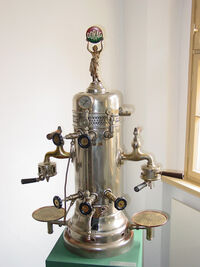
An early style of espresso machine.
Early
espresso machines were large and ornate, using gas as their heat source. They
consisted of large, cylindrical reservoirs turned on their end, with several
spouts, valves, and gauges protruding from the front and sides. Finally, the
espresso machines were topped with an ornate figurehead, most often an eagle.
These
early machines were limited to the amount of pressure that could be produced by
the steam alone--around one and a half atmospheres (meaning one and half times
the pressure exerted by the earth's atmosphere), not high enough to allow for
full extraction of the coffee oils or use a heavily packed puck of coffee.
Higher steam pressure could be generated from using more heat, but the hotter
water caused the coffee grounds to become overheated as well, damaging the
taste of the resulting cup.
In 1947, Achille Gaggia developed
a modification to espresso machines which, instead of using steam pressure to
drive the water through the coffee, used a manually pulled lever to cause a
piston to press the hot water through the coffee. The higher pressure generated
through this method allowed for a much tighter packed puck of coffee and a more
full extraction of the coffee's flavors. Additionally, through this method, the
signature crema that floats at the top of a properly prepared espresso was
first born. Despite continuing improvements, modern espresso makers are still
mostly based upon Gaggia's model.
One
of the drawbacks to the Gaggia machine was that both the water for the espresso
and the steam were heated in the same tank. The water would heat slowly, and
would become stale over time, affecting the quality of the resulting espresso.
In 1961, the FAEMA company
(Fabbrica Apparecchiature Elettromeccaniche e Affini or, in English, factory producing electrical and mechanical equipment and similar)
developed the E61, a machine which would heat water for use in brewing the
espresso by passing it through the tank of older water before it got to the
brew head. The fresh water would never interact with the older water, which
would be reserved for use only in the production of steam. Other improvements
in the E61 included an electric-driven pump, a mechanism for decalcifying water
(so as to not to contaminate the machine with deposits), and the ability to
circulate water through the group head so that it would reach a warm
temperature prior to brewing without having to run water through it first.


